The All-in-One Myth: Why Your Restaurant Is Losing Money on Software That Promises Everything
FBHcontrol team · 5 min read
You've probably seen the pitch before. A sales rep walks in, or pops up in your inbox, with a slick demo of a platform that does it all: takes orders, tracks inventory, manages payroll, handles accounting. One login, one dashboard, one subscription. Sounds like a dream, right?
Here's the truth: in the restaurant and hospitality world, that dream is costing you real money. And most owners don't realize it until the damage is already done.
The restaurant business is not like other businesses
A restaurant is, at the same time, a retail store, a factory and a service operation. You're buying raw ingredients, transforming them into finished products and selling them, all in real time, under pressure, with perishable goods, variable demand and a team that's constantly turning over.
This is a penny business. The margins are razor thin. You don't win by selling more; you win by controlling what happens to every ingredient from the moment it arrives at your back door to the moment it reaches the guest. No accounting software was designed to do that. And no POS system, however sophisticated, was built for it either.
What POS and accounting systems are actually good at
POS systems are excellent at what they do: recording sales, managing tables, processing payments. Accounting platforms handle your payables, your P&L and your taxes. The problem starts when either of them tries to be your inventory and cost control system. What a POS inventory module almost never does:
- Calculate your ideal (theoretical) cost based on actual sales and standardized recipes.
- Compare ideal vs. actual cost continuously, to reveal exactly where you are losing money.
- Track inventory through the full production cycle: purchasing, prep, batch production, portioning and waste.
- Give you cyclical, actionable operational reports: daily for high-cost items, weekly for perishables, monthly for everything else.
When a restaurant owner doesn't know what good looks like, and most don't, because this methodology is rarely taught, the module seems to be working. It shows numbers. It generates reports. It feels like control. It isn't.
The hidden cost of "almost good enough"
A casual dining operation running a 32% food cost figures that's normal for the segment. The POS inventory module shows costs tracking close to that number, so management feels comfortable. What nobody sees:
- Portioning on the two highest-cost proteins is running 8–12% over standard.
- Batch preparation is generating yield losses nobody is tracking.
- Three menu items that account for 40% of sales have ideal costs 4 points lower than actuals.
- Weekly ideal-vs.-actual comparisons would reveal patterns pointing to unregistered sales or internal theft.
At a restaurant doing $200,000 a month in sales, a 3–4 point improvement in food cost is $6,000–$8,000 per month back in your pocket. That is up to $96,000 a year, from a software gap.
Why ERPs don't fix this either
As groups grow, someone proposes an ERP. But ERPs were designed for manufacturing and distribution, not for recipe-based production with perishables and real-time operational cycles. A real-world example: a 40-location chain used a specialized inventory system successfully for 15 years, then migrated to a world-class ERP during an accounting overhaul. After more than three years of struggle and significant consulting costs, the custom adaptations still hadn't solved the core problem. The specialized tool did in minutes what the ERP couldn't do reliably at all.
The right model: specialized tools that work together
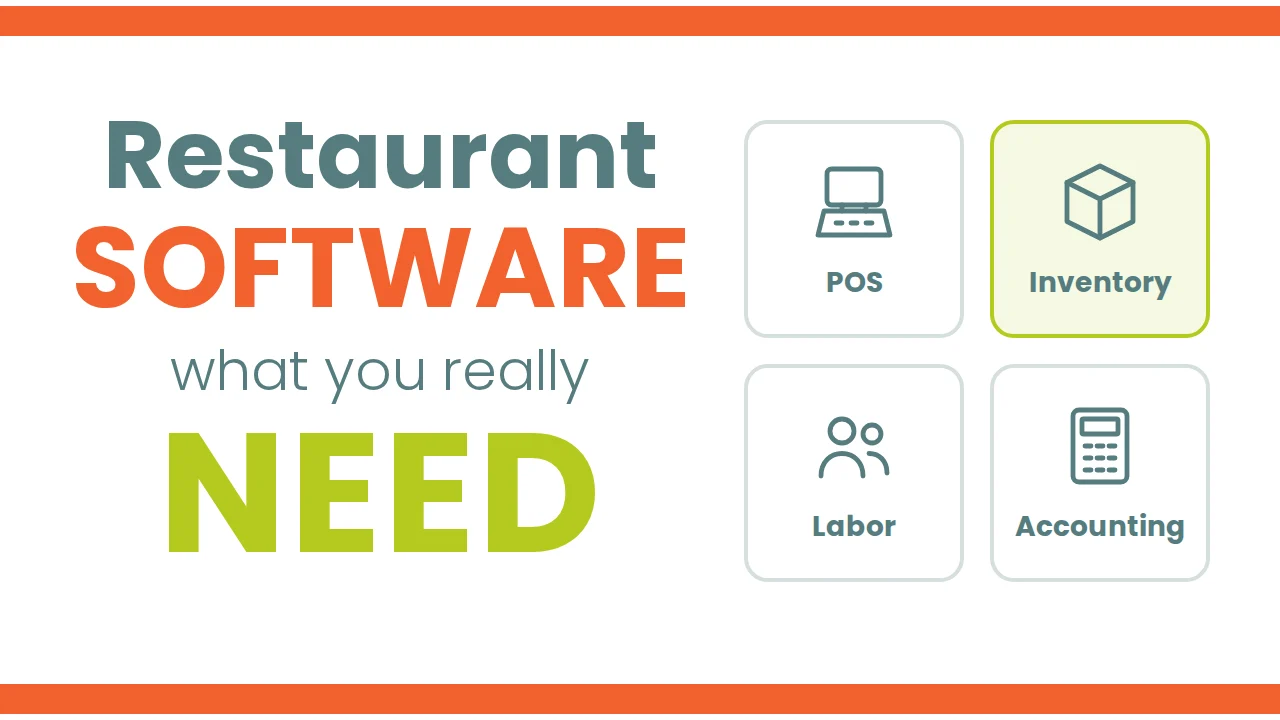
The right technology stack for a restaurant looks like this:
- A POS system chosen for operational excellence: speed, reliability and staff usability.
- An accounting system chosen for financial compliance and reporting.
- A dedicated inventory and cost control system that integrates with both, built specifically for food service.
Each tool does what it does best. Data flows between them. The inventory system acts as your operational nerve center, telling you every day whether your actual costs match what they should be, based on what you sold.
35 years of doing one thing right
FBHcontrol was built on exactly this premise: not as an afterthought inside a POS, not as an accounting add-on, but as a purpose-built system for the specific, complex challenge of inventory and cost control in food service.
The methodology, developed over 35 years of real restaurant operations by Ernesto Daza, author of Mastering the Restaurant Business, tracks every ingredient through the complete cycle: from purchase order to receiving, through production and portioning, all the way to the plate. It calculates what you should have used. It compares that to what you actually used. And it tells you, with precision, where the variance is and what is causing it.
It integrates cleanly with your POS and accounting system. It doesn't try to replace them. It just does the one thing they can't do, and does it exceptionally well.
What to ask before you buy
- Can it calculate ideal (theoretical) cost based on actual sales and standardized recipes?
- Does it compare ideal vs. actual cost continuously, not just at month-end?
- Can it identify exactly which ingredient, in which category, is generating variance?
- Does it handle the full production cycle, including batch prep, yield factors and waste?
- Was it built specifically for food service, by people who understand the operational reality?
If the answer to any of those is "not exactly" or "we're working on that", you already know what you're dealing with.
The all-in-one solution is a compelling story. But in the restaurant business, compelling stories don't pay the bills. Controlling your costs does.
— FBHcontrol. Specialized by design. Proven for 35 years.